First week March 2022 - I'm going to Munich

Since I went back to Mexico, and I started typing here again, I promised to myself I'd do it more often, the reason being that it provides a sort of catharsis, even if I don't always write about matters directly affecting me. Where I go wrong, methinks, is in trying to provide much detail or in trying to satisfy an imaginary audience, which in the end derives in it taking a much longer time and effort than it should.

I'll soon be leaving Taipei and gonna be heading to Munich. I've taken a job with IQM as a quantum physics engineer, where I'll work mainly characterizing their superconducting device and thinking about error mitigation/correction.

By the way, we put up a new paper on the arXiv recently on more RB for non-Markovian noise. Despite this one being less sexy than its predecessor when it comes to plots or figures (spoiler alert, there is none at all), I feel like it is hot nevertheless, mathematically and physically, even though as always, there are things that can be improved or addressed further.

Towards a general framework of Randomized Benchmarking for non-Markovian Noise
Pedro Figueroa-Romero, Kavan Modi, Min-Hsiu Hsieh

I will be cutting my 2-year contract in Taipei to a single year, with the main reason being twofold: the first is that the borders are not yet opening, and the second is the lack of diversity, mainly in the workplace. To be fair, people have been great with me, especially the team leader and director of the institute, Min-Hsiu Hsieh.

When it comes to IQM, from the places I sent requests or applications to, it was, I would say, my second priority: to be honest, Zapata was the first one, although mostly for selfish reasons (essentially I don't think I had quite the right profile for any of their vacancies). Regardless, I am super excited about taking up my role; ironically, without my year in Taipei, I don't think I would've been perceived as having the right profile, or it would've been much more difficult getting in. Also, the topic of device characterization in general has revived much of the passion I'd lost for research.

About Munich, so far the only issue I have is the high costs of living coupled with the high taxing rates. Even though I will be earning more than what I currently am, I will be having quite less after taxes and accommodation, which is a tad depressing. I guess it's a reason why the expats that decide to come to Taiwan like it so much, cause you can afford a much higher quality life with much less.

One thing I'll totally be missing is riding a bike, which was, unexpectedly, an amazing experience! This weekend at last I went around the north coast, only with a little climb at the beginning in Fengguizui. I'd been wanting to do this ride for a while, so I decided it was now or never, and didn't disappoint, even reminded me a bit of Beach Rd in Melbourne. I also took the chance to visit the Temple of Eighteen Lords again!


A Cup of Sake Beneath the Cherry Trees

It is foolish to be in thrall to fame and fortune, engaged in painful striving all your life with never a moment of peace and tranquillity. Great wealth will drive you to neglect your own well-being in pursuit of it. It is asking for harm and tempting trouble. Though you leave behind at your death a mountain of gold high enough to prop up the North Star itself, it will only cause problems for those who come after you. Nor is there any point in all those pleasures that delight the eyes of fools. Big carriages, fat horses, glittering gold and jewels – any man of sensibility would view such things as gross stupidity. Toss your gold away in the mountains; hurl your jewels into the deep. Only a complete fool is led astray by avarice. Everyone would like to leave their name unburied for posterity – but the high-born and exalted are not necessarily fine people, surely. A dull, stupid person can be born into a good house, attain high status thanks to opportunity and live in the height of luxury, while many wonderfully wise and saintly men choose to remain in lowly positions, and end their days without ever having met with good fortune. A fierce craving for high status and position is next in folly to the lust for fortune. We long to leave a name for our exceptional wisdom and sensibility – but when you really think about it, desire for a good reputation is merely revelling in the praise of others. Neither those who praise us nor those who denigrate will remain in the world for long, and others who hear their opinions will be gone in short order as well. Just who should we feel ashamed before, then? Whose is the recognition we should crave? Fame in fact attracts abuse and slander. No, there is nothing to be gained from leaving a lasting name. The lust for fame is the third folly. Let me now say a few words, however, to those who dedicate themselves to the search for knowledge and the desire for understanding. Knowledge leads to deception; talent and ability only serve to increase earthly desires. Knowledge acquired by listening to others or through study is not true knowledge. So what then should we call knowledge? Right and wrong are simply part of a single continuum. What should we call good? One who is truly wise has no knowledge or virtue, nor honour nor fame. Who then will know of him, and speak of him to others? This is not because he hides his virtue and pretends foolishness – he is beyond all distinctions such as wise and foolish, gain and loss. I have been speaking of what it is to cling to one’s delusions and seek after fame and fortune. All things of this phenomenal world are mere illusion. They are worth neither discussing nor desiring.


Yoshida Kenkō was a Buddhist hermit from early 14th-century Japan; this Penguin book is a selection from his Essays in Idleness. The book reminded me strongly of the Meditations of Marcus Aurelius; it is a sort of stream of consciousness work dealing with many topics about life, nature, virtue and other things, many of which seem really close to Western philosophy from similar times. Some of his remarks, such as the comments on women are utterly outdated and absolutely not PC, and nevertheless, some observations are, methinks, more needed today than they probably ever were, such as the quote I cited above.

Temple of the Eighteen Lords

A temple that is all about praising dogs... yep, you can find such thing in Taiwan. Specifically, I'm referring to the Temple of the Eighteen Lords (in Mandarin, 十八王公廟 or Shíbāwáng Gōngmiào), located at the very north of Taiwan.

The story is quite interesting, from Wikipedia:

According to legend, during the Qing Dynasty, a boat carrying seventeen people and one dog capsized near the coast of northern Taiwan. All of the people died, but the dog survived. When residents on the shore were burying the dead, the dog jumped into the grave to be buried as well.[a] Locals then immortalized them collectively as the "Eighteen Lords".[1]

And according to the same Wikipedia article, "In the 1980s, the temple was popular among gamblers playing dajiale (a type of illegal lottery) and sex workers." I find it surprising that none of the Taiwanese that I've spoken to (to be fair, not that many... lol), were not aware about the existence of the temple.

Apparently it's not super easy to get there on public transport from Taipei. While, of course, I wanted to see the temple, my main motivation was to ride there: it took some 85km and 2,000m of climbing but most of it on nice roads and accross the mountains, so a tad hard but super enjoyable.

Preprint on RB and non-Markovianity

We just put up a new preprint on randomised benchmarking for non-Markovian noise at https://arxiv.org/abs/2107.05403 !

Randomised benchmarking for non-Markovian noise

Estimating the features of noise is the first step in a chain of protocols that will someday lead to fault tolerant quantum computers. The randomised benchmarking (RB) protocol is designed with this exact mindset, estimating the average strength of noise in a quantum processor with relative ease in practice. However, RB, along with most other benchmarking and characterisation methods, is limited in scope because it assumes that the noise is temporally uncorrelated (Markovian), which is increasingly evident not to be the case. Here, we combine the RB protocol with a recent framework describing non-Markovian quantum phenomena to derive a general analytical expression of the average sequence fidelity (ASF) for non-Markovian RB with the Clifford group. We show that one can identify non-Markovian features of the noise directly from the ASF through its deviations from the Markovian case, proposing a set of methods to collectively estimate these deviations, non-Markovian memory time-scales, and diagnose (in)coherence of non-Markovian noise in an RB experiment. Finally, we demonstrate the efficacy of our proposal by means of several proof-of-principle examples. Our methods are directly implementable and pave the pathway to better understanding correlated noise in quantum processors.

Fourteentine, Taiwanese bureaucracy and loneliness

I started typing this entry in the middle of the mandatory 14-day quarantine* imposed by Taiwan on anyone entering the country, and never really got to complete it, even when I was trapped in that hotel room 24/7. As everything in life, while in quarantine it felt like it would never end (the day after it finished, my feeling was even a bit surreal and I felt kind of afraid of having to face the outside world), but now it feels like it went by in the blink of an eye. I guess all I can complain about was the absurdly high price of the quarantine hotel, but at least I was treated well and really had all I needed to make it through.

For some reason I sometimes feel that writing in here does not make sense at all, and some others I feel that not only is it good for me mentally but it leaves some more permanent information about my thoughts when I'm gone, or when I might need to recall some things. I'm, at least at this second, trying to commit myself to write at least once a week, without caring much about detail, which is, I think, what deters me in the first place from writing or at least keeps me from concluding whatever thought process I want to capture in writing. I guess I just have to forget a bit about style detail and precision when it comes to this thing.

Anyhow, my first status complain is that bureaucracy in Taiwan is an absolute drag. It's funny because I used to think about Taiwan as some very technologically advanced country which would have automated many things and would be very efficient in dealing with many formalities. This is just not so, and some things even seem to make little sense. To be fair, many things do work to a great extent like the strictness they've had with covid-19 and so on. Anyhow, I concluded my quarantine on May the 4th and got sorted almost all bureaucratic chores I needed to. I'm very much looking forward to resuming my life.

While being a postdoc abroad definitely feels different to being a PhD student abroad because of the professional part, there are things in personal life that do feel like going back in time in a negative way. And this is especially true if one is single (i.e. not married) and faces being in a new place with no acquaintances; add to this the unusual circumstance where you're required to initially isolate yourself at least for 22 days and things get a bit worse. And don't get me wrong, it's great to have a life experience like this and being able to live in different places and truly immerse yourself in a totally different environment, but I guess at some point it feels a bit exhausting, even more if you feel that you actually can't call this or that place home.

Today I was particularly reminded of this because I grabbed my camera and went out to check Taipei 101 (台北101) and Elephant Mountain (象山). This kind of reminded me of some shitty times in Melbourne by my own, even when actually trying some photography sort of helped me feel better back then. It also somehow intensified the uneasiness of being in a long-distance relationship (LDR). As I tried to elaborate some entries below, it's just impossible to remain the same person and there is just no way of genuinely sharing feelings all the time when both eventually live through entirely different things. Now, surely some people can empathise better than others, and I guess the first is the type that eventually make it through in LDRs.

* Quarantine literally implies a 40-day isolation period. In Spanish this is easily adapted to imply a 14-day period turning the word 'cuarentena' into 'catorcena'. Or well, okay, maybe not.

I'm going to Taiwan

...I've been telling people for about four months now. Even I started to doubt it was gonna happen and repeatedly blamed myself for not securing other options. Thinking about it though, for moves like these, I think one has to think of time-frames of several months to conclude everything. The whole wait in the end was definitely my bad, cause I only verbally accepted the offer after I had submitted my PhD thesis and was practically, even if not technically, done with my degree.

Perhaps worse than the wait, is the uncertainty: not knowing when things are gonna be finally done with and facing new bureaucratic barriers time and time again. In any case, I'm now quite excited about getting there, even if I have to clear a 14-day mandatory quarantine in an outrageously expensive hotel. I'm looking forward to going full-on with the postdoc and discussing things with people, with some ideas already on randomized benchmarking, unitary designs and some quantum machine learning. I also can't wait to get on a bike again and ride the big hills around Taipei and maybe later in some other exciting spots in Taiwan.

A couple of reads

The internet didn’t kill counterculture—you just won’t find it on Instagram at Document, by Caroline Busta.

I read this one a while ago but it pop out back in conversation. It's funny how the internet is such a great tool for democratisation, to boost discussion and creativity, but at the same time it can become this omnipresent force that quietly but effectively damps authentic expression, originality and dichotomy. After this then there's the thin line between freedom and transgressing the other, as well as a plethora of other issues arising from such accessibility.

Then,

Your Professional Decline Is Coming (Much) Sooner Than You Think at The Atlantic, by Arthur C. Brooks

This article feels like riding a roller-coaster, but just as it usually happens with roller-coasters, I really enjoyed reading it. Perhaps the most relevant point is an invitation to reflect on how whatever we do professionally identifies us and how success can become an overwhelming and detrimental metric of our worth and well-being. Rather than offering a fatalistic view on the reality of ageing, the article invites to think about adapting and enjoying the different stages of life with the physical and mental capabilities available to us at the time. Similarly, the discussion from the author about Darwin and Bach reminded me of the situation in physics and how my perception about Academic success has changed so much.

Vive L'amour

I used the final day of Tsai Ming-liang's retrospective on Mubi to watch Vive L'Amour (愛情萬歲, Àiqíng wànsuì translated to Long live love).

I confess that before that, I struggled a bit to watch Stray dogs (郊遊, jiāoyóu translated to Excursion), which was a bit too slow for the state I was in; I also find harder to watch films like it in a setting that's not a cinema. I decided to pick a different one and went for Vive L'Amour: while the style was very similar (long shots, silence and not much dialogue) I was much more engaged with it. Given that these two are much more recent than Rebels of the neon God, I reckon this is closer to the defining style of Tsai Ming-liang.

In a nutshell, I'd say the film is about love, sex, loneliness and depression in a contemporary setting (1990's in Taipei). I found it funny, moving, sad, sombre and joyful all at once. It's hard to describe masterpieces like these and make them justice, one can discuss at length and seemingly never conclude; one just has to experience them.

My week's films

I watched First Reformed (2017) by Paul Schrader (starring Ethan Hawke and Amanda Seyfried) on Saturday and it left me thinking about it for the rest of the weekend.

The film slowly burns just to finally explode in the final scene. Ethan Hawke masterfully plays Reverend Ernst Toller, a protestant pastor struggling with several personal issues like the death of his son and alcoholism, his thoughts being captured in a handwritten journal which he plans on keeping for a year and to destroy it after a year. He then meets Mary (Amanda Seyfried), a pregnant attendant to church, who asks for his help in counselling her husband, a troubled man who is not wanting to keep their child. Then many issues start coming into play and we slowly see Toller free-falling, with Mary being perhaps his only source of comfort with whom he develops a strong non-sexual emotional connection.

I found the whole film enjoyable, and despite it being a bit sombre, it has some beautiful scenes (namely the floating one), although there are some cliched depictions and so on (probs would not make happy a fair chunk of religious people). Then I found the final scene absolutely marvellous, I think it is somewhat up to interpretation, but if you understand how troubled the mind of Toller is, you might have a different perspective on it; in brief, I think he does go ahead with the drano, with the last seconds unfolding only in his head, until...

Then, just yesterday, I found out about a streaming of some of Tsai Ming-liang's films on Mubi. Naturally I'm currently interested in finding out more about Taiwanese cinema; I now recognise, for example the names Edward Yang or Hou Hsiao-hsien, also the film A Sun (陽光普照) Chung Mong-hong, streaming on Netflix, is highly recommendable. I first heard about Tsai Ming-liang from this beautiful video on Fandor:

The streaming of the films is part of UNAM's 11th international film festival (FICUNAM) based here in Mexico. Unfortunately, the streaming of Ming-liang's films, specifically, only lasted from the 18th to the 24th of March.

Anyhow, I had the chance to watch Rebels of the neon God, in Chinese "青少年哪吒" (Qīngshàonián Nézhā) literally meaning Teenage Nezha; from Wikipedia:

The Taiwanese title refers to Nezha, a powerful child god in Chinese classical mythology who was born into a human family. Nezha is impulsive and disobedient. He tries to kill his father, but is brought under control when a Taoist immortal (Nezha's spiritual mentor) gives the father a miniature pagoda that enables him to control his rebellious son.

Many things can be said about the film. The only bad thing about it really is that it doesn't seem to be readily available online: films like these are nowadays at least available for rent, but apparently not this one or other Tsai Ming-liang's films. Hopefully during my time in Taiwan I'll be able to find these and other cornerstone Taiwanese films more easily in stores or otherwise.

Canto XXX de El Infierno en La Divina Comedia

Estando otra vez en casa, tengo a mi alcance bastante libros que muchos considerarían básicos pero que yo jamás leí. Entre éstos está La Divina Comedia, de Dante Alighieri.

En particular, me encuentro en el Canto XXX de El Infierno, del cual me ha encantado el final:

Yo estaba escuchándoles atentamente, cuando me dijo mi Maestro: — Sigue, sigue contemplándolos aún, que poco me falta para reírme de ti.

Cuando le oí hablarme con ira, me volví hacia él tan abochornado, que aún conservo vivo el recuerdo en mi memoria: y como quien sueña en su desgracia, que aun soñando desea soñar, y anhela ardientemente que sea sueño lo que ya lo es, así estaba yo, sin poder proferir una palabra, por más que quisiera excusarme; y a pesar de que con el silencio me excusaba, no creía hacerlo así.

Con menos vergüenza habría bastante para borrar una falta mayor que la tuya —me dijo el Maestro—: consuélate; y si acaso vuelve a suceder que te reúnas con gente entregada a semejantes debates piensa en que estoy siempre a tu lado, porque querer oír eso es querer una bajeza.

Por supuesto se requiere un poco de contexto para entender a qué va esta cita. Como sea, La Divina Comedia es una obra que uno puede gastarse la vida pensando en ella.

Timing

Someone told me the other day that things tend to happen in their right moment, even if we feel that they are taking too long or that others have taken too short.

While certainly this cannot be objectively true (things can always happen more favourably), it reminded me of two popular sayings:

Los tiempos de Dios son perfectos. (The timings of God are perfect.)

Cuando te toca, ni aunque te quites, y cuando no te toca, ni aunque te pongas. (When it's your time, it doesn't matter if you move away, and when it's not, doesn't matter if you put in place.)

While I rationally wanna hold that thinking in this way is a means of comforting oneself with whatever outcomes we get in life, I like the feeling of letting go of things I cannot control and just admit that there are things I will never be able to comprehend.

Freedom, responsibilities and losing my mind

So far, all major transitions in my academic —or professional if you'd consider a PhD a real job— life have taken quite long, with more or less fault of my own.

When I first entered university, I was already a year behind because I'd dropped out of high-school before and hadn't had my diploma ready (surprisingly for me and all who knew me back then, I passed the standardised test to enter the major Mexican university, UNAM to study Economics).

Then on the undergrad to master's transition I lost a year from when I finished to when I started in Edinburgh; while this was my fault to a degree, it was a choice and the wait was virtually inevitable, I honestly don't remember many highlights of that year other than attending the graduation (which I did mostly to thank my parents), doing a s**tton of bureaucracy and attending some schools and conferences as a non-presenting student. In this stage my life continued almost normally and I had my friends and family; what was painful was the whole wait of outcomes: the English test (IELTS in my case), the university applications (if I remember correctly I narrowed my options to only two programs in the UK, the other was at Uni Glasgow and I turned it down), the scholarship(s) and the visa. I wrote about this back in the day (in Spanish) and the whole timing was just right, I don't think it could've been done much differently. In any case, as I said, it was totally worth it, that was literally the second time I stepped on a plane (first on my own and first travelling abroad) and the whole thing made me mature and grow incommensurately.

Then the master's to PhD transition lasted half a year (Oct 16 to March 17), which wasn't so bad, considering I only started looking and applying shortly after back in Mexico; here the major issue was the uncertainty of not knowing where I'd end up or what I'd end up doing: back in Edinburgh I had focused on theoretical particle physics and I was looking for alternatives, as I wasn't keen on pursuing research in the field, I even remember sending a couple of emails to do research in renewable energies! The only other good offer I remember turning down was a doctorate in Probability and Statistics at CIMAT. The longest wait was for the paperwork in the university, I only had an informal offer from my supervisor but the formal acceptance took some 3 to 4 months; surprisingly the visa process was extremely quick, I just had to fill some forms and take the letter from the university and in a couple of days my visa was ready. I remember some really bad days and this time the feeling that I was already too old to be living at my mother's house and being paid everything started to bother me; I also didn't get a job during this time and had almost no savings left (fun fact, when I received my first payment in Melbourne, I'd left my Mexican bank account with less than 100 MXN or approx 5 USD).

Now it's been a similar story and I would say I am mostly at fault, since I knew that I had to be looking for positions and start filling up applications before finishing the PhD and I only did so after having submitted my thesis. Even then, it still took a little more than two months for the company to finish writing my contract (mind you, the institute is newly created, literally having started this year), then lunar year, and now the visa process, so a lot of it was out of my hands.

Now I can identify two (highly correlated) main sources of stress that are making me go insane: economic dependency and lacking real responsibilities. These are correlated because I can't really get one going without the other and more generally my life seems to be on hold until these two are clear. Also, it's quite strange because even though I am free to do whatever I want during this time, I don't feel quite free because I'm tied to this insolvency and the wait to get things going in Taiwan.

It's funny but during the PhD I became very square with regards to my schedules and I felt quite a lot of distress when the pandemic hit and I couldn't get on my day as usual. Now it's kind of the same, and even though I have a routine already during my stay in Mexico, it feels lack of a clear objective and overall sense. It's a tad ironic that having so much freedom actually can make you go insane. It reminds me of Camus' or other existential philosophers' discourses.

Anyhow, they say it gets darkest just before dawn, and I'm pretty sure I'm now seeing the end of it.

甜約翰 (Sweet John) - 安全範圍 lyrics with pinyin


你崇尚煙火般的熱烈
Nǐ chóngshàng yānhuǒ bān de rèliè
看不清是誰為你冒險
Kàn bù qīng shì shuí wèi nǐ màoxiǎn
追求自信過剩的曖昧
Zhuīqiú zìxìn guòshèng de àimèi
躍過安全範圍才算得上
Yuèguò ānquán fànwéi cái suàndé shàng


體驗 危險帶來的滋味
Tǐyàn wéixiǎn dài lái de zīwèi
純潔遲早被摧毀
Chúnjié chízǎo bèi cuīhuǐ
迷戀只是種謊言
Míliàn zhǐshì zhǒng huǎngyán
烈火終究會熄滅
Lièhuǒ zhōngjiù huì xímiè


自由給你太多 浪費的藉口
Zìyóu gěi nǐ tài duō làngfèi de jíkǒu
愛只不過是你 驕傲的把戲
Ài zhǐ bùguò shì nǐ jiāo'ào de bǎxì
我提醒著自己絕不能再輕易
Wǒ tíxǐngzhe zìjǐ jué bùnéng zài qīngyì
忘記最不獨特的 其實是自己
Wàngjì zuì bù dútè de qíshí shì zìjǐ


自由給你太多 浪費的藉口
Zìyóu gěi nǐ tài duō làngfèi de jíkǒu
愛只不過是你 驕傲的把戲
Ài zhǐ bùguò shì nǐ jiāo'ào de bǎxì
我提醒著自己絕不能再輕易
Wǒ tíxǐngzhe zìjǐ jué bùnéng zài qīngyì
忘記最不獨特的人 原來是自己
Wàngjì zuì bù dútè de rén yuánlái shì zìjǐ
原來是自己
Yuánlái shì zìjǐ
原來是自己
Yuánlái shì zìjǐ


自由給你太多
Zìyóu gěi nǐ tài duō
愛只不過是你
Ài zhǐ bùguò shì nǐ

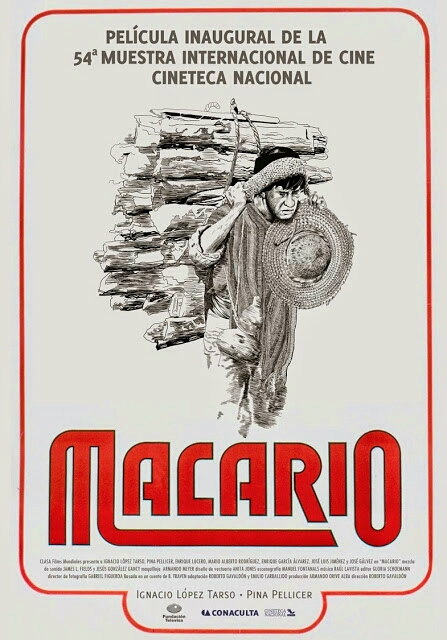
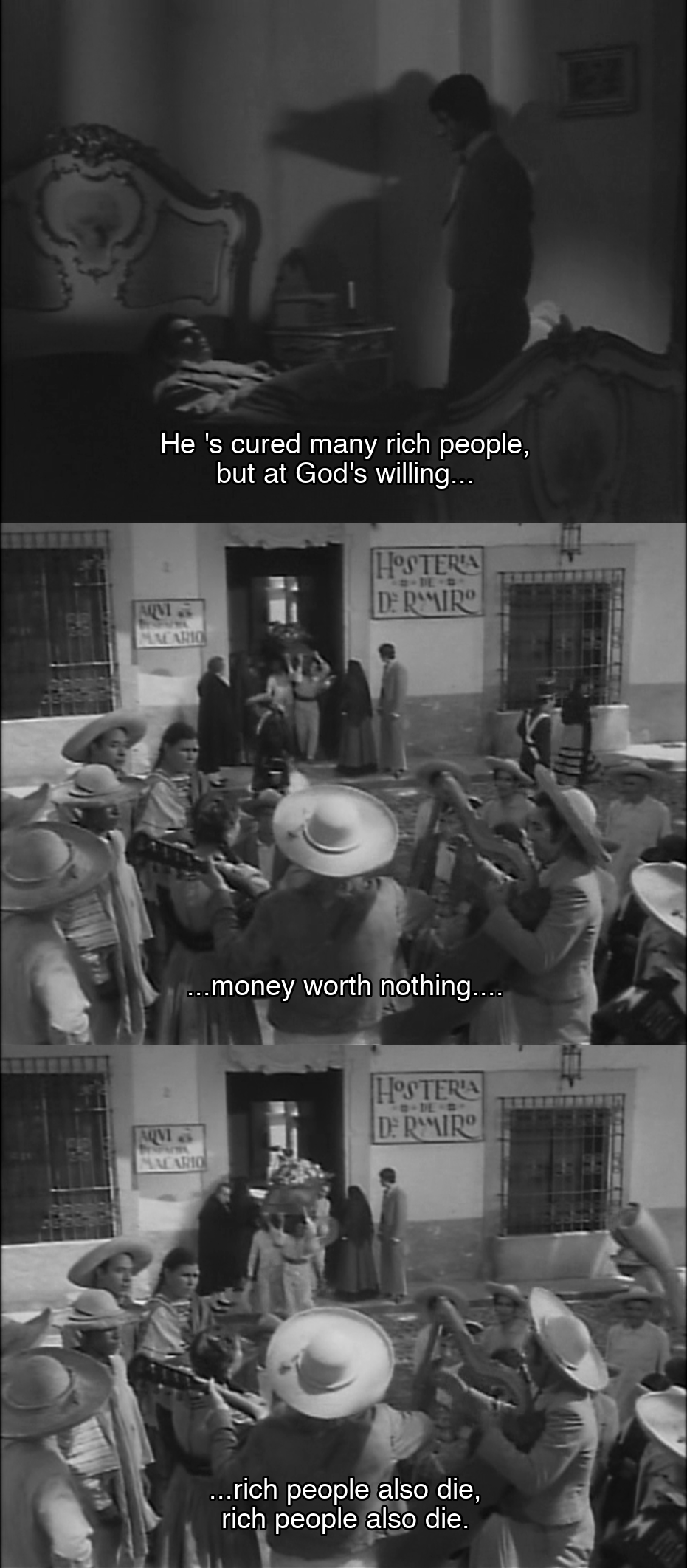
Macario

For many Mexican generations preceding mine, Macario is a well-known film from the so-called Golden age of Mexican cinema. For me, it was for a long time just another old film of the kind that my grandparents would watch. Then as I started getting deeper into cinema per-se, I knew this was a basic title I should watch, and now I admit I'm slightly ashamed to have seen it after so long in my life. Before saying anything else, I must reaffirm Macario is one of the true gems of Mexican cinema, a masterpiece that should be an essential for any self-declared cinephile, independently of their nationality.

I've often seen Macario being described as a "supernatural" film and for some reason this puts me off badly. Others, I've seen it described as a "macabre fairy tale". What you should know is that the film deals with the two basic elements of life/death and poverty/wealth in a style reminiscing of Ingmar Bergman's The Seventh Seal, with several cultural and social undertones and criticism. I only later found out it is actually based on a German folk tale (literally described as a fairy tale) called Godfather Death, which was adapted by a mysterious author known as Ben Traven, of German origin, to a Mexican colonial era context.

I'll just give away the basic premise, which I think is enough to entice one to see it.

Macario is a Mexican peasant in colonial Mexico (think of between 1600 and 1800) with several kids and a wife, who despite working hard in the mountains carrying logs, can barely afford to feed his family and himself. Looking at the wealthy, and specifically when he sees some roast turkeys being made, he makes a vow to have a whole turkey for himself or starve to death. In a sequence of heart-touching scenes, his wife steals a turkey and selflessly gives it to him; he runs away and as he prepares to eat it, he meets first the Devil, then God and finally Death (in the form of a peasant), who ask for him to share the turkey with them.

Ignacio López Tarso, currently 96, and Pina Pellicer, who despite achieving stardom, committed suicide at 30.

Macario decides to share the turkey with Death and not the Devil or God, by the following reasoning: first, the Devil just wanted to trick him, why would he trade the turkey for gold or shiny things (they would chop off his hands for thinking he's a thief anyway) if the didn't even share it with his family? Then, while regretting not sharing with God, he reasons God is the owner of absolutely everything, so why would he need anything from Macario? But finally, with Death he says, "when you showed up, I thought I wouldn't even get a chance to eat... when you show up there is no time for anything else... I figured if I gave some to you at least I'd get a chance to eat too". This is just marvellous and beautifully executed by Ignacio López Tarso, who plays Macario. Everything unfolds after this when Death offers to reward Macario and elements such as greed, inequality, religion, racism, classism, and then again death, become evident.

On the penultimate scene, Macario is found at Death's cavern (shot at the beautiful Grutas de Cacahuamilpa), which is filled up with candles representing people's life (the wax and length of the candle standing for the lifespan of the given person). When Macario spots his candle and realises how short it is, he begs Death to save it, and seeing his refusal, he decides to take it and run away with it. The final scene then goes back to the day Macario first talked to Death.


Overall, this is a fantastic and beautiful piece of cinema capturing diverse cultural, social and life elements, some of which are inherently timeless inescapable aspects of life, others which still permeate society today, and a few which make Mexican culture absolutely unique.

Missing out

It's been some 6 years now for me being away from home; while it's been rewarding in many regards, and I would absolutely not change it, it's been hard leaving people behind, or as I'm finding out now, reuniting with them, as they are not them anymore. And I don't mean this in a bad way, but simply that just as I made my life elsewhere and became someone else, so did they.

Now the most daunting prospect of moving once again is leaving a relationship behind and trying to keep it alive in long distance for a year. And I just realised that probably my biggest fear in this sense is simply that: missing out on her growth and evolution as a person and her missing out on mine, just not being there, becoming someone else. It is true that effective communication should go a long way, but even with my family I'm realising that even though I kept up to-date with most things, I still missed plenty of important moments: laughter, sadness, common struggle, dancing, face gestures, overall intrinsically sharing certain aspects of our view of life, etc. Then all the emotions that go with little things, that seemingly can only be shared by being alive there and then, together.

Then, for some reason my mind likes to play this futile game of filling up gaps, creating an artificial picture of things where I couldn't live through them; I suppose it's a way to create the illusion of understanding and empathy/connection with the other. This is mostly harmless to myself with family, but in the case of a special other it turns into a stinging feeling that can at times veer dangerously into insecurity and jealousy. On the other hand, how could you possibly accurately capture whatever is going on in your life, with all its richness (be it good or bad) without them living it there, locally in space-time, together with you?

I've been faced with the prospect of trying a long distance relationship before but at least in a couple there wasn't even a discussion, whereas with another we figure it would just not work and didn't deem it worth it. I feel like this time I approached things with much more naivety than I thought and that when people say it's hard they are implying many invisible but nevertheless pervasive hardships.

Fulfilment by Gustav Klimt

Religion and Science

When it comes to books, it is sort of true that there are only two kind of people in the world: those who read them and those who buy them. I'm sometimes more of the second one, I left several books unread from Australia and I found several I never read back in Mexico. Anyhow, one of those I left back here in Mexico is The World as I see it by Albert Einstein, which contains several essays and writings by Einstein on diverse non-technical matters.

The following is a chapter in such book that I particularly liked. It appeared first in the New York Times Magazine on November 9, 1930.

Image from The New Yorker (Ernst Haas/Getty)

Everything that the human race has done and thought is concerned with the satisfaction of deeply felt needs and the assuagement of pain. One has to keep this constantly in mind if one wishes to understand spiritual movements and their development. Feeling and longing are the motive force behind all human endeavor and human creation, in however exalted a guise the latter may present themselves to us. Now what are the feelings and needs that have led men to religious thought and belief in the widest sense of the words? A little consideration will suffice to show us that the most varying emotions preside over the birth of religious thought and experience. With primitive man it is above all fear that evokes religious notions - fear of hunger, wild beasts, sickness, death. Since at this stage of existence understanding of causal connections is usually poorly developed, the human mind creates illusory beings more or less analogous to itself on whose wills and actions these fearful happenings depend. Thus one tries to secure the favor of these beings by carrying out actions and offering sacrifices which, according to the tradition handed down from generation to generation, propitiate them or make them well disposed toward a mortal. In this sense I am speaking of a religion of fear. This, though not created, is in an important degree stabilized by the formation of a special priestly caste which sets itself up as a mediator between the people and the beings they fear, and erects a hegemony on this basis. In many cases a leader or ruler or a privileged class whose position rests on other factors combines priestly functions with its secular authority in order to make the latter more secure; or the political rulers and the priestly caste make common cause in their own interests.

The social impulses are another source of the crystallization of religion. Fathers and mothers and the leaders of larger human communities are mortal and fallible. The desire for guidance, love, and support prompts men to form the social or moral conception of God. This is the God of Providence, who protects, disposes, rewards, and punishes; the God who, according to the limits of the believer's outlook, loves and cherishes the life of the tribe or of the human race, or even or life itself; the comforter in sorrow and unsatisfied longing; he who preserves the souls of the dead. This is the social or moral conception of God.

The Jewish scriptures admirably illustrate the development from the religion of fear to moral religion, a development continued in the New Testament. The religions of all civilized peoples, especially the peoples of the Orient, are primarily moral religions. The development from a religion of fear to moral religion is a great step in peoples' lives. And yet, that primitive religions are based entirely on fear and the religions of civilized peoples purely on morality is a prejudice against which we must be on our guard. The truth is that all religions are a varying blend of both types, with this differentiation: that on the higher levels of social life the religion of morality predominates.

Common to all these types is the anthropomorphic character of their conception of God. In general, only individuals of exceptional endowments, and exceptionally high-minded communities, rise to any considerable extent above this level. But there is a third stage of religious experience which belongs to all of them, even though it is rarely found in a pure form: I shall call it cosmic religious feeling. It is very difficult to elucidate this feeling to anyone who is entirely without it, especially as there is no anthropomorphic conception of God corresponding to it.

The individual feels the futility of human desires and aims and the sublimity and marvelous order which reveal themselves both in nature and in the world of thought. Individual existence impresses him as a sort of prison and he wants to experience the universe as a single significant whole. The beginnings of cosmic religious feeling already appear at an early stage of development, e.g., in many of the Psalms of David and in some of the Prophets. Buddhism, as we have learned especially from the wonderful writings of Schopenhauer, contains a much stronger element of this.

The religious geniuses of all ages have been distinguished by this kind of religious feeling, which knows no dogma and no God conceived in man's image; so that there can be no church whose central teachings are based on it. Hence it is precisely among the heretics of every age that we find men who were filled with this highest kind of religious feeling and were in many cases regarded by their contemporaries as atheists, sometimes also as saints. Looked at in this light, men like Democritus, Francis of Assisi, and Spinoza are closely akin to one another.

How can cosmic religious feeling be communicated from one person to another, if it can give rise to no definite notion of a God and no theology? In my view, it is the most important function of art and science to awaken this feeling and keep it alive in those who are receptive to it.

We thus arrive at a conception of the relation of science to religion very different from the usual one. When one views the matter historically, one is inclined to look upon science and religion as irreconcilable antagonists, and for a very obvious reason. The man who is thoroughly convinced of the universal operation of the law of causation cannot for a moment entertain the idea of a being who interferes in the course of events - provided, of course, that he takes the hypothesis of causality really seriously. He has no use for the religion of fear and equally little for social or moral religion. A God who rewards and punishes is inconceivable to him for the simple reason that a man's actions are determined by necessity, external and internal, so that in God's eyes he cannot be responsible, any more than an inanimate object is responsible for the motions it undergoes. Science has therefore been charged with undermining morality, but the charge is unjust. A man's ethical behavior should be based effectually on sympathy, education, and social ties and needs; no religious basis is necessary. Man would indeed be in a poor way if he had to be restrained by fear of punishment and hopes of reward after death.

It is therefore easy to see why the churches have always fought science and persecuted its devotees.On the other hand, I maintain that the cosmic religious feeling is the strongest and noblest motive for scientific research. Only those who realize the immense efforts and, above all, the devotion without which pioneer work in theoretical science cannot be achieved are able to grasp the strength of the emotion out of which alone such work, remote as it is from the immediate realities of life, can issue. What a deep conviction of the rationality of the universe and what a yearning to understand, were it but a feeble reflection of the mind revealed in this world, Kepler and Newton must have had to enable them to spend years of solitary labor in disentangling the principles of celestial mechanics! Those whose acquaintance with scientific research is derived chiefly from its practical results easily develop a completely false notion of the mentality of the men who, surrounded by a skeptical world, have shown the way to kindred spirits scattered wide through the world and through the centuries. Only one who has devoted his life to similar ends can have a vivid realization of what has inspired these men and given them the strength to remain true to their purpose in spite of countless failures. It is cosmic religious feeling that gives a man such strength. A contemporary has said, not unjustly, that in this materialistic age of ours the serious scientific workers are the only profoundly religious people.

Piedras que hablan

Durante mi tiempo en Melbourne estuve cerca de comprar una televisión, principalmente porque disfruto del cine. Hasta que fui adolescente, crecí viendo televisión: a mis 10 años de edad, o algo así, instalaron servicio de cable y todos teníamos televisión en nuestra recámara. Aún hoy en día, que regreso a vivir un tiempo en casa de mi madre, la televisión se ve de manera cotidiana aunque algunas televisiones únicamente tienen servicio de transmisión por internet (o sea pues, streaming). Los noticieros son usuales durante las comidas, plagados de anuncios de televentas y cuyo contenido, por cierto, al menos de los canales populares (Foro tv, Azteca, Televisa), parece diametralmente opuesto al de los noticieros en Melbourne: un porcentaje abrumador del contenido llamado "noticia" es relacionado con crimen y violencia de todos niveles. Y vaya, no es que aquello con todo y una cantidad estúpida de anuncios, e igualmente en todos los niveles, no exista en Australia, pero si uno comparase lado a lado los noticieros el contraste sería impresionante. Luego de ésto, es notable la disponibilidad de programas de entretenimiento que literalmente son como un masaje entumecedor del pensamiento; y no me refiero tanto a la mala comedia, que puede ser más bien cuestión de gustos, sino por ejemplo a los programas en que uno ve a gente concursando juegos del tipo que adolescentes ebrios juegan nomás por convivir. Es tristísimo pensar que tanta gente consume ese contenido día tras día, y es quizá un factor bastante importante para entender la situación socio-política de latinoamérica.

Pero bueno, luego de esta diatriba, también cabe rescatar que hay producciones de calidad para la televisión, de donde destacan por ejemplo el Canal Once, que aunque aún un poco lejos, ha mejorado mucho durante los años con un buen balance entre contenido cultural y de entretenimiento. Lo que realmente quería decir en esta entrada es mi impresión con la serie "Piedras que hablan", producida por Canal 22 y el INAH, presentada por Juan Villoro.

Hasta ahora he visto tres capítulos: Teotihuacan, Chichén Itzá y Templo Mayor. Mi favorito sin duda ha sido Templo Mayor, y los tres me han hecho lamentar no haber puesto atención tanto en clases de Historia en la secundaria o bachillerato, como en las veces que llegué a visitar los sitios (a excepción de Chichén Itzá, que pude visitar apenas en 2018). Una de mis partes favoritas son las imágenes y descripción en el Templo del Sol (o de Tonatiuh), donde se muestra un pilote colonial (presuntamente de la catedral metropolitana) a un lado de una piedra ornamental, y posiblemente con significados asociados a la belleza y el Sol, conocida como chalchihuite (o chalchihutl, que en náhuatl significa jade). Esta descripción que literalmente las piedras relatan, sobre la lucha, caída y, en cierto sentido, venganza de Tenochtitlán con la España del siglo XVI es simplemente magnífica. El Templo Mayor es por mucho el sitio que ahora me parece el más fascinante de nuestra historia prehispánica, sencillamente porque marca esa transición y choque de civilizaciones que hoy nos define,  y que lamentable poco he visto y estudiado.

Sumamente recomendable procurar ver la serie completa, y también recomendaría en general suscribirse al canal del INAH en Youtube; frecuentemente tienen transmisiones de seminarios u otros eventos, así como una gran variedad de vídeos que nos pueden hacer sentir orgullosos de ser mexicanos y mostrarnos que hay producciones televisivas o de vídeo/audio de suma calidad en México.


The art museum and the circus

I arrived in Melbourne in 2017 and I avoided the NGV (National Gallery of Victoria) for the most part of my stay. The NGV is an art museum and one of the iconic places at the heart of the city, right behind the famous Flinders Street Railway Station. I mostly avoided it because it strikes me as pretentious and lavish, generally not my type of place to experience art, even though historically art, just as science, has been almost exclusive for privileged people, it makes me uneasy whenever I perceive it to be treated that way (same with mathematics or science).

To be fair, and to start with the positive note, I did avoid the Gallery to my own detriment, as it does have some amazing pieces in its permanent collection. I did happen to visit, however, during a contemporary art exhibition called Triennial. I generally say I don't like contemporary art because the line between art and entertainment, between the deep and the banal, the everlasting and the immediate becomes too blurry for me. Now, the thing with the arts is that there is no true definition of what constitutes art and what does not; even if one can point to elements that must be present in a piece, like aesthetics, intelligence and technique, most of these are still subjective.

I do think, however, that the institutional display of most contemporary art (such as the one displayed at the Triennial) comes with a price for society at large. It seems like most people qualify any creative piece with an elevated sense of depth as art. These tend to be the same people that think that the act of reading should be fun, or that mathematics has value only if it can be applied; this is not to say that reading can't be fun or that applied mathematics are not valuable, but the act of reading is generally an intellectual exercise that should start a dialogue with the author that might face us with uncomfortable questions and make us think (which is largely a difficult and uncomfortable thing to do), and mathematics has a value in itself as the purest form of thought we know and perhaps the only way we have of defining and uncovering truth. It seems to me then that the price of such displays in art museums is a society that can't distinguish these from amusement parks, from circuses (circi?), from glossy instagrammable installations with flashy lights and/or colors. Now, similarly I don't intend to say that all contemporary is consumable fast food with no nutritional value, but rather that a large part of it is sold and perceived as something much more that what it actually is, bringing masses to institutional places selling mainly entertainment as artistic expression.

In the end, contemporary art does deserve a place and people with respective credentials should get to decide what gets displayed where; as things stand today, however, in many places it seems like the line between an art museum and an amusement park is quite hard to draw.

Porky Hefer at the NGV Triennial

On avoiding death

While these days back home I haven't been able to see friends and family for obvious reasons, at least I was able to see my grandma. She won't come out of her apartment almost for nothing, my mom takes care of most of the household chores, buying groceries and so on. And when she steps inside my grandma's apartment, she does so wearing a mask and a face shield; mind you, I proceeded in the same way.

In a sense, I guess in this situation we're all intentionally escaping death, either our own, someone else's, or both. And I guess we all go to different lengths to avoid it, we all give up something, some of us more and some of us less. What has surprised me the most during this pandemic is the selfishness of so many people in this regard, not understanding that them not giving up their normality can cost someone else's well-being or ultimately their life.

Overall, anyway, we all just seem to naturally want to perpetuate [our]  life at all costs. Even those aforementioned selfish bastards are laughing until they're not. As some people say, life's purpose seems to be simply to perpetuate itself and nothing else. That's perhaps the thing I find the most odd about suicide: it completely goes against the purpose of life whilst being the only true thing we have a power to choose (as opposed to everything in life, including to live). In a similar vein, I find as somewhat curious the joy that most people find in newborns or small kids, and how in a sense these result more valuable than older lives: a suicide of a middle aged person is intrinsically less tragic than that of a teenager.

These are just spare and somewhat disjoint thoughts on life and death that came to mind this morning and I felt like writing. As Albert Camus, I believe the one truly serious philosophical problem is suicide, and overall I tend to agree for the most part with Emil Cioran's thought that it's not worth the bother of killing yourself, since you always kill yourself too late.

Death And Life, 1908 by Gustav Klimt

Road cycling

It's been almost a month since I haven't ridden a (real road) bike. About a year and a half into my PhD I bought a road bike, influenced by a good friend of mine, and it totally changed my life and my perception of Melbourne, not to mention helping me stay afloat in some very dark days.

Even though I loved my bike and I actually invested quite a considerable amount in accessories and parts, I decided it was not worth it to carry it to Mexico and then to Taiwan. My plan is to get a road bike in Taipei asap when I get there; how quick I'll do this will depend on several factors.

I enjoyed my time riding in Melbourne and it's one of the things I will miss dearly. At first I'd always start riding at Clayton and my favourite routes would include taking the Scotchman's Creek trail to the city, riding on Beach Road, where I reached Mount Martha several times and climbed Arthur's Seat at least once, riding some of the climbs on the Dandenong Ranges like the "1/20" or "The Wall", doing some laps at Albert Park Lake, or taking the Yarra Boulevard for its sake or en route to other places such as Mount Pleasant road up in Research (yes, there's a suburb called that).


Melbourne was such an amazing place to ride in; I wish I could've ridden in other places in Australia as well, but I was busy doing my PhD. Anyhow, I'm now looking forward to riding in Taiwan; hopefully I'll be able to find a place where commutes to work will be nice and for sure I'll be eager to explore the country by bike whenever possible. There's also the famous Taiwan KOM Challenge, which I'd be happy to try in case it gets on during my time there.